Sunday Hunting

I posted this to my All things Krista blog today and felt it should be included in Blue Ridge Pony

***

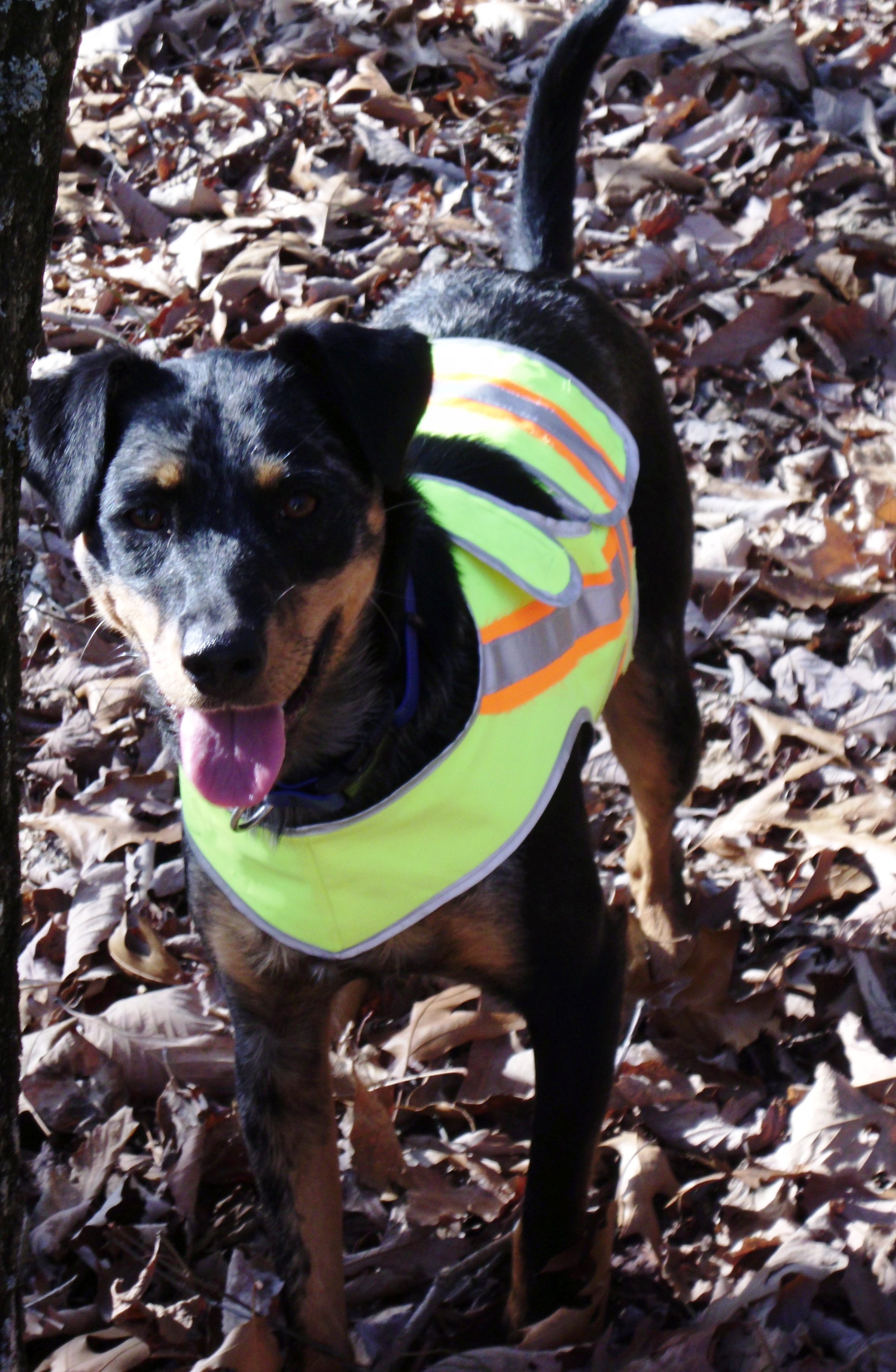
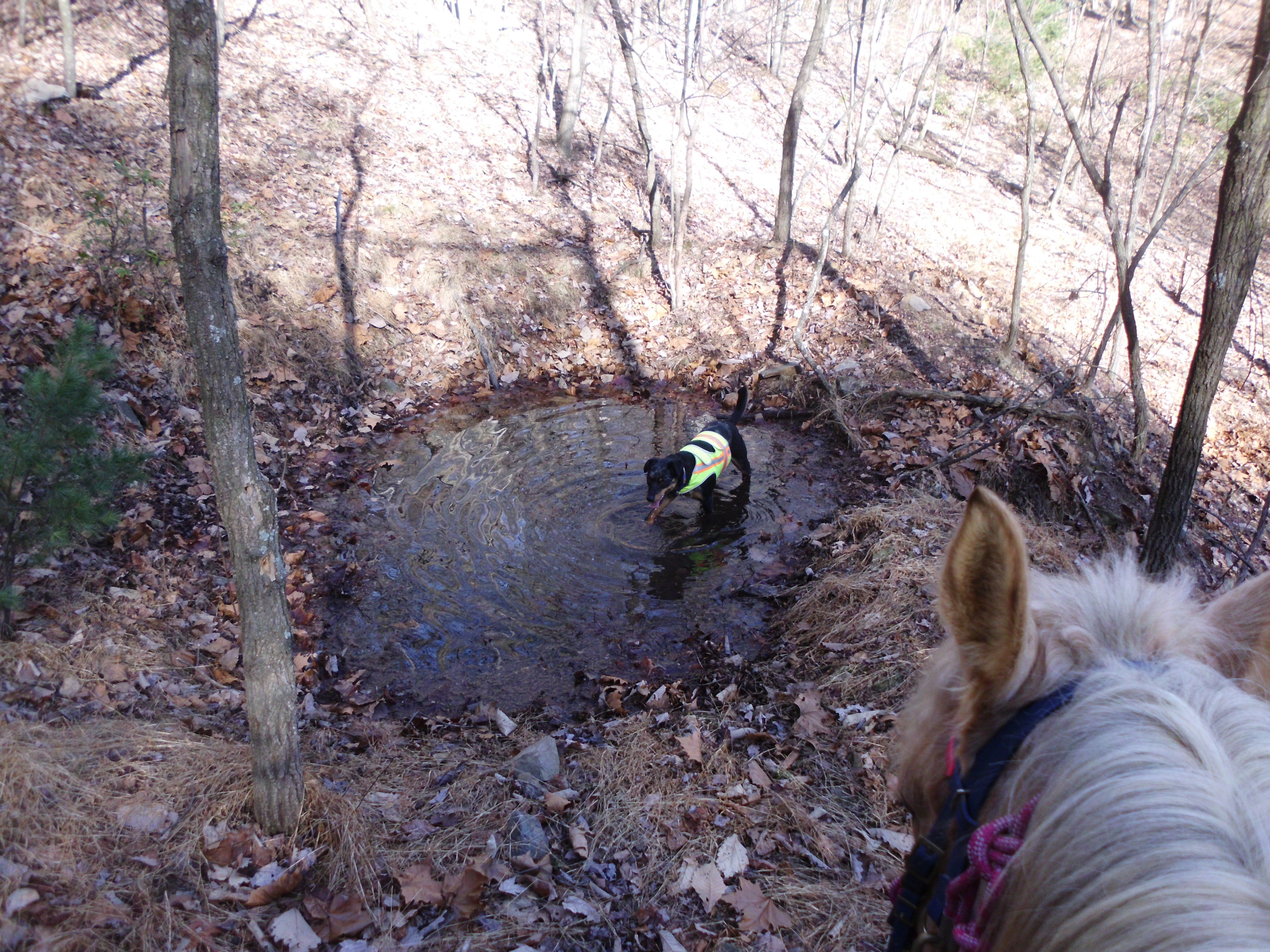
Daisy Dog and I wear high-vis vests in the woods, even on Sundays

Currently there is a bill going through Virginia politics that would open the state to hunting on Sundays, which is currently not permitted.  Many people are opposed to this because Sunday is the only day during a large portion of the year (as you can see on the calendar) that is safe for people to take part in non hunting outdoor activities like hiking, bird watching, mountain biking, horse riding, etc.

I am a very active Virginia trail rider and enjoy spending Sundays in the forest with my dog and my pony.  I sent emails to the pertinent people in regards to this bill politely expressing my concern and was pleased to receive a response from several of them thanking me for my opinion.

The proposed bill to allow Sunday hunting made it through the senate in January.  Today the VA House of Delegates’ bill on Sunday Hunting died in committee by unanimous vote.  Which is great.  But the House still needs to vote down the bill the Senate passed. 

The Virginia Horse council put out this really neat calendar that shows all of the hunting days in Virginia. 

*Looking at the VA hunting guidelines, it is apparent that the VA Horse Council left off some hunting days on the calendar.  There is a spring squirrel season that runs into June and also a few other days that were missed throughout the calendar. 

*I do support hunting and I understand and agree with its need.  I just want to be able to enjoy the forest as well. 

***

Report from All Things Krista  http://allthingskrista.wordpress.com/2012/02/02/hunting-on-sundays/

Interaction with the Forest Service

After a few calls I managed to speak with someone at the local, North River Forest Service Disctrict office.  WOO!  I had a list of question, some of which I forgot in my excitement to speak to someone, but I got a couple answered. 

The two fire road turn offs, 536F & C at Bear Trap are most likely the two places I feel they are.  They were probably used for logging and that area has not been logged in 10 or 20 years so they were closed up so people couldn’t drive on them.  They are still available to be used but are not being maintained.  He also went on to tell me that on my horse I can ride any and everywhere I choose in the forest, I just can’t clear trails or bring my chainsaw, but to enjoy myself and explore where ever I want. 

Next I asked him about trail 439 that had the wooden signs taken down and now has the green tree tags.  He told me that the local bicycle club got permission to put up the green tags (they have SVBC Shenandoah Valley Bicycle Club on them! Duh Krista!) on trails they are working on and maintaining.  He said the FS is no longer putting up the wooden signs because of people vandalizing them and they are putting up metal signs that are made just like street signs, but they are still brown.  He said they get stolen or kicked down and thrown into the woods all the time.  He is going to pass on to the appropriate person that the signs are not up for that trail any longer too. 

I was so thrilled to talk to someone who was happy (or at least sounded like he was) to talk to me, and truly helpful!  He didn’t just answer my questions but elaborated and really tried to give me useful information.  He knew exactly what area, fire roads and trail I was talking about right away and he didn’t make me feel stupid or like a burden or anything.  It was fantastic.  His name was something like Christopher or something Chris sounding.  Or so that’s what I heard the receptionist call him. 

I had meant to ask about the gates being opened and what the schedule is for that, and what the criteria was for some gates to be open versus others.   And if I am ok to drive up in there in my truck or horse trailer (assuming there is turn around space for the trailer), if they check before locking the gates. 

Anyway, it was a really exciting and positive interaction, and since there have been strained relations with the local FS and the local riders/trail users lately, it made me feel even better about it. 

*To the best of my knowledge, the main issues with the local FS has been more in, what I think is the Lee District area, centered around Cub Run and Catherine’s Furnace. 

Games Equipment for a Not-For-Profit Group

We have our own little games group, Blue Ridge Games, which is part of MGAA – Mounted Games Across America.  MGAA is a non-profit 501c3 national organization, with the sole intent of promoting, educating and providing mounted games opportunities.  BRG is also an all volunteer group, that tries to offer mounted games opportunities in an area where games is a bit new.

We need to have our own set of games equipment to really operate.  So far BRG has been able to barrow equipment for our competitions and we use my own personal equipment for practices and we have been able to make that work.  But it really adds an obstacle to hosting a competition and it’s a lot to ask of other people.

Creating your own personal set of equipment is not an inexpensive task, but some things can be skimped on and fabricated, although often to a not-quite-standard degree.  Which does not always work for a competition set of equipment.  For a competition set, you need to have 4 -6 sets of each item, and they all need to match and be to specifications.

There are also a lot of heavy metal, specially made pieces that are expensive to purchase and are a bit difficult to find.  There are two current games people that create and sell these metal items.  One, The Steel Pony, is the original artist for metal games equipment in the USA.  Operated by Mark, he originates in PA but recently moved to FL.  The other seller is a family in Kentucky.  They both make excellent equipment that lasts a life time.  We are talking about items you can gift to your kids who will then in turn gift to their kids.  Once you purchase these items you are set for life.  Although because of location, handing over equipment is a task that can take a year or more to arrange.

When it comes to expense, these items add up.  With the rise in metal prices the cost of a single bending pole has shot up some, being close to $60 each, and metal costs continue to rise.  Each set requires 5 poles.  So at last year’s $60 price, one set costs $300.  Our little BRG group needs 4 sets of everything to make the cut, which would run us $1200.  Wow right!

Because our little group can hardly afford to purchase one or two poles in a good year, we decided to check with the local vo-tech center that operates as part of the public school system.  They agreed to make the bases for us at cost!  Score!  We could still only afford two sets, 10 bases total, but it’s a start.  I have a set of matching poles as do two others in our group, so between us and the new bases we actually have five lanes!  Crazy!

Of course we still need to save up for the wooden poles, which will cost about $70 for both sets.  But shoot, we are just happy to have the bases for now.

Blue Ridge Games – Spring Dates

Myself and my friends, Carol Ann, Linda and Kelly, host a mounted games series that we call Blue Ridge Games. We even have our own Facebook https://www.facebook.com/blueridgegames and web page http://blueridgegames.org/ dedicated to it.

We attempt to provide the Blue Ridge Valley with local mounted games competitions, clinics and practice opportunities and I have set up three dates for this coming year so far. 

  • March 18, 2012 Clinic and open Practice
  • April 15, 2012 Clinic and open Practice
  • September 1, 2012 BRG Fair Demo, Shenandoah Fair

These events will be hosted at the Shenandoah Fairgrounds in Woodstock, Virginia and anyone can take part. 

So what is mounted games?

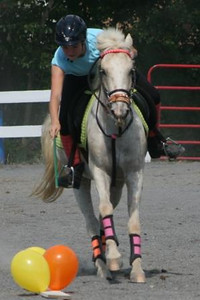
I can best describe it as relay races on horseback.  Riders are generally set up on teams.  The riding area is arranged with matching lanes.  Teams are line dup at one end of the playing field behind a line, one team per lane.  A referee starts the race with the drop of a flag.  The first rider on each team races through an obstacle that has been preset in their lane, and then “hands off” with a teammate who then races through the obstacle.  The finish is called in the order the final rider of each team crosses the finish line. 

Races are generally run one after the other, with the same teams of riders staying in the playing field and completing 10-18 races within a one hour session.  The order of completion in each race gains a predetermined amount of points for each team, and at the end of the session those points are added up for a final score and placement. 

That’s the basics. 

Mounted games gives riders the opportunity to ride on a team, where working together is paramount to completing each race. 

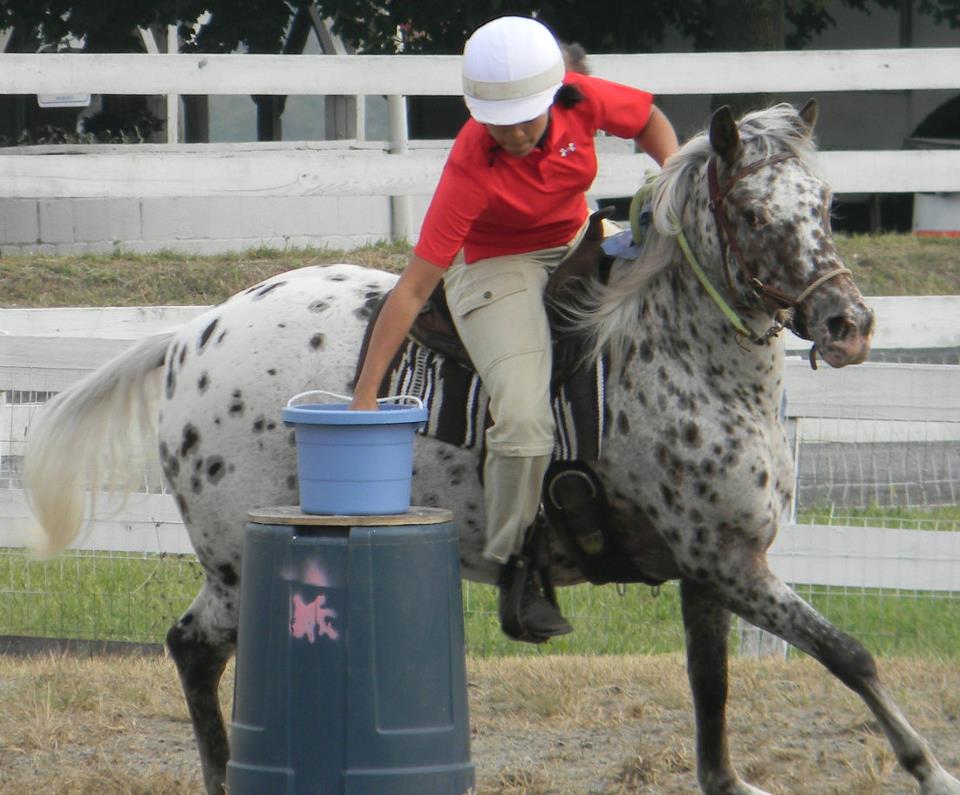
Because all of the equipment in the lane must be left in a specific condition at the end of the race, riders must decide how fast to push their pony without disturbing the equipment.  If, for example, riders are riding around a barrel, and they knock the barrel over, it must be righted and returned to its original position before that rider can continue.  Finding the fastest speed to go around the barrel without knocking it over is a key element in games. 

But generally in games you do not just ‘go around a barrel’.  You most likely need to retrieve an object from that barrel, or place one on it while going around it.  So riders are then required to figure out how close they need to get to the barrel to pick up the object, while still keeping speed and not knocking it over. 

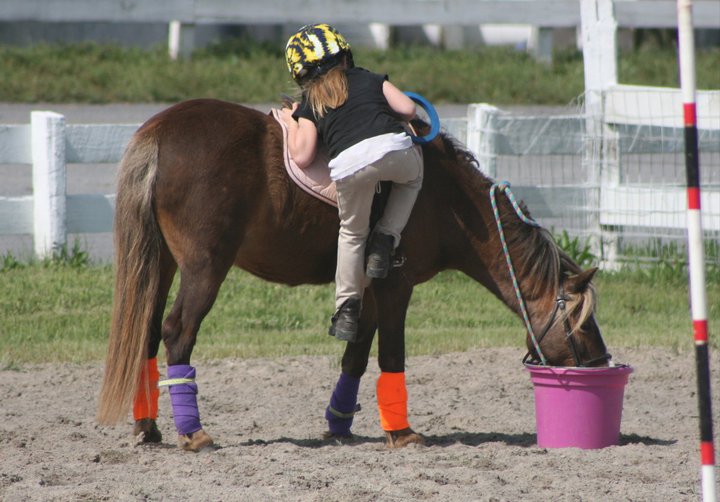
Some races require riders to dismount, retrieve an object and then remount before continuing.  This encourages riders to perform a vaulting mount without the aid of stirrups.  Generally reserved for the younger more agile riders, feats of vaulting onto ponies at a full gallop are spectacles to witness, but they do require a lot of training of the pony and practice of the rider to accomplish.  Spills happen.    

Lots of fun to take part in and with an array of divisions that are directed toward riders of different age and skill level, mounted games is a sport for many. 

I have been playing games since I was 9 years old,  and although Simon just started a year ago, he is already a fabulous games pony.  Simon and I ride on a team, Old School, in the adult (fossil) division.  Being part of a team is amazing, and I will be sure to post about it in the future. 

We generally take the winter months off, although there are still games competitions taking place.  We have our first one coming up at the end of February.  Our calendar packs in after that, with games dominating about every other weekend through October.  No worries, you will hear a lot about it if you choose to follow this blog.

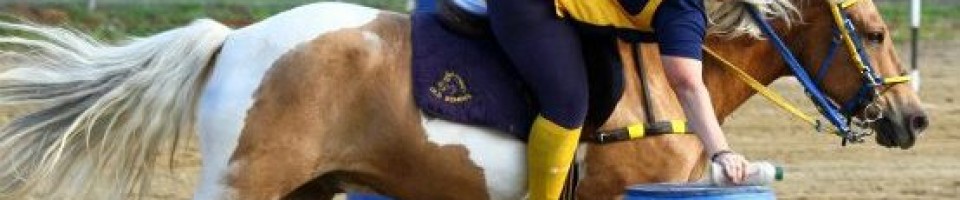
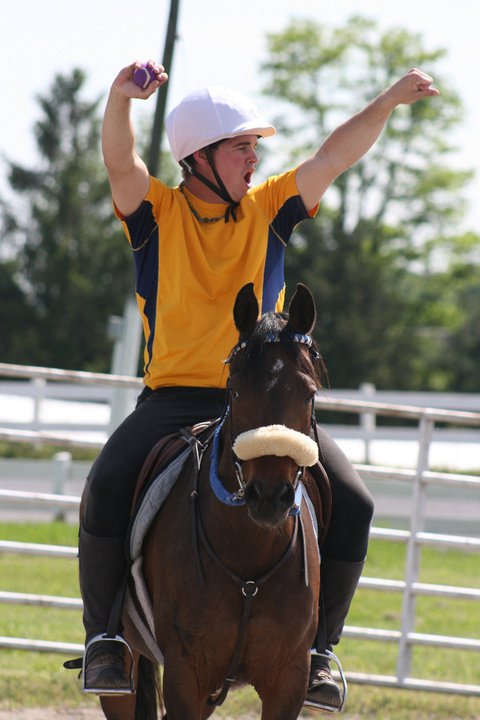
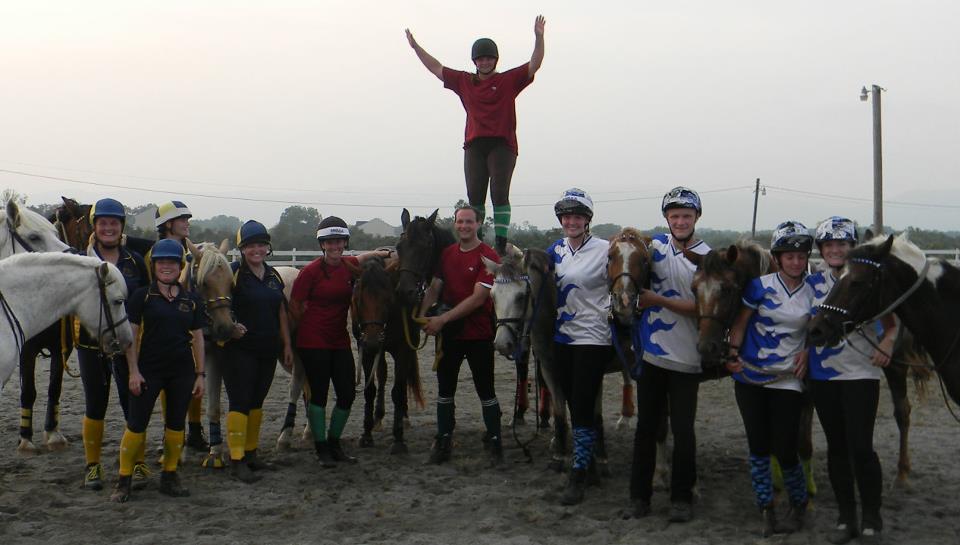
Three of the teams at the Fall Demo 2011

Trail Report: Bear Trap Fire Road #536C

Where’s That Fire Road UPDATE

Trail Report: Bear Trap exploration – the first fire road #536C

January 8, 2012

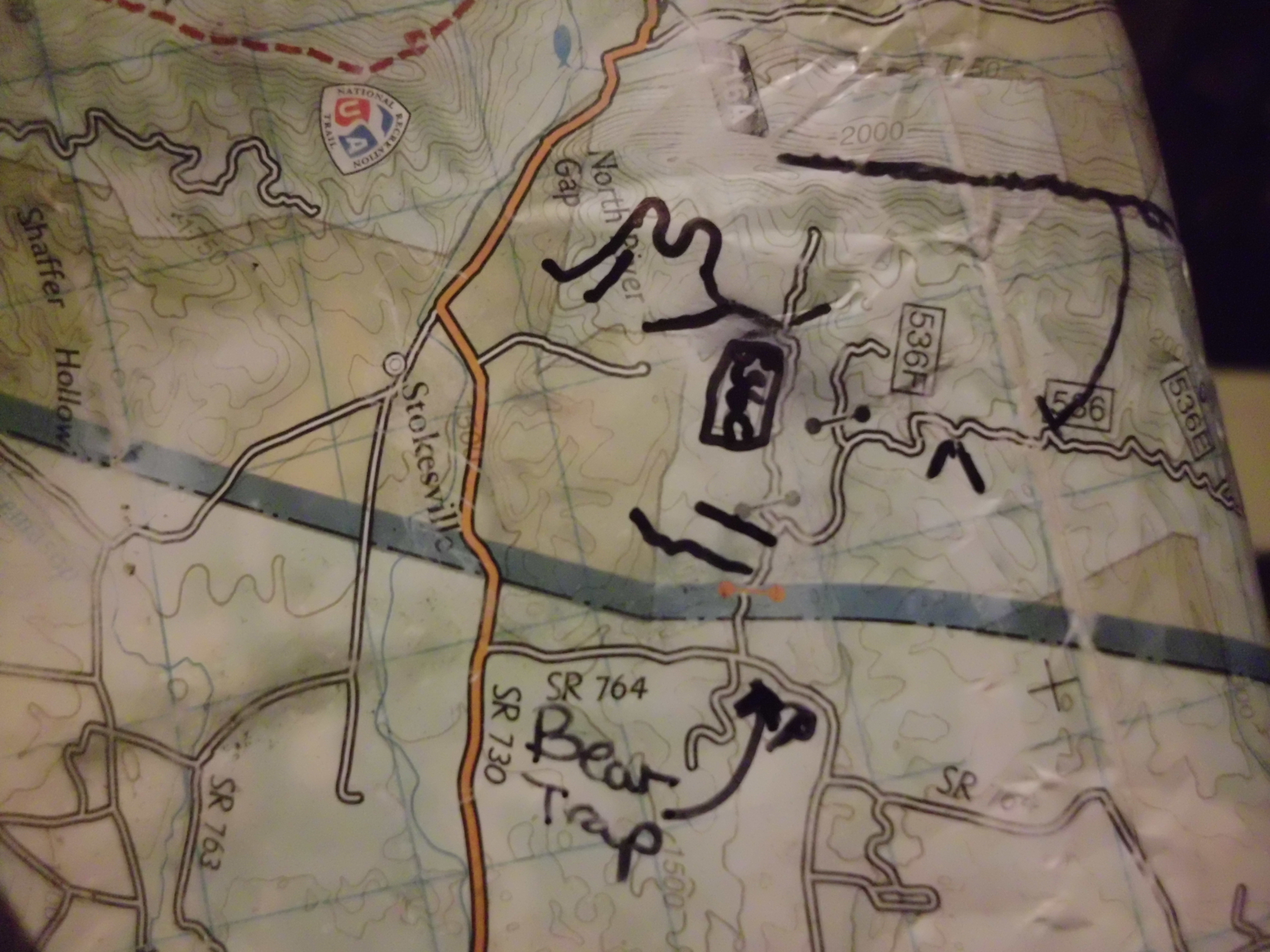
I think I found the first fire road and I spent my day exploring it.  I have drawn in the trails I talk about below in the locations I think they are to the best of my non-artistic ability. 
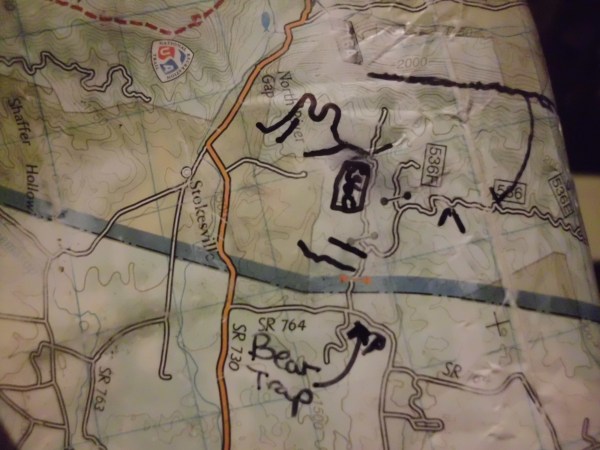
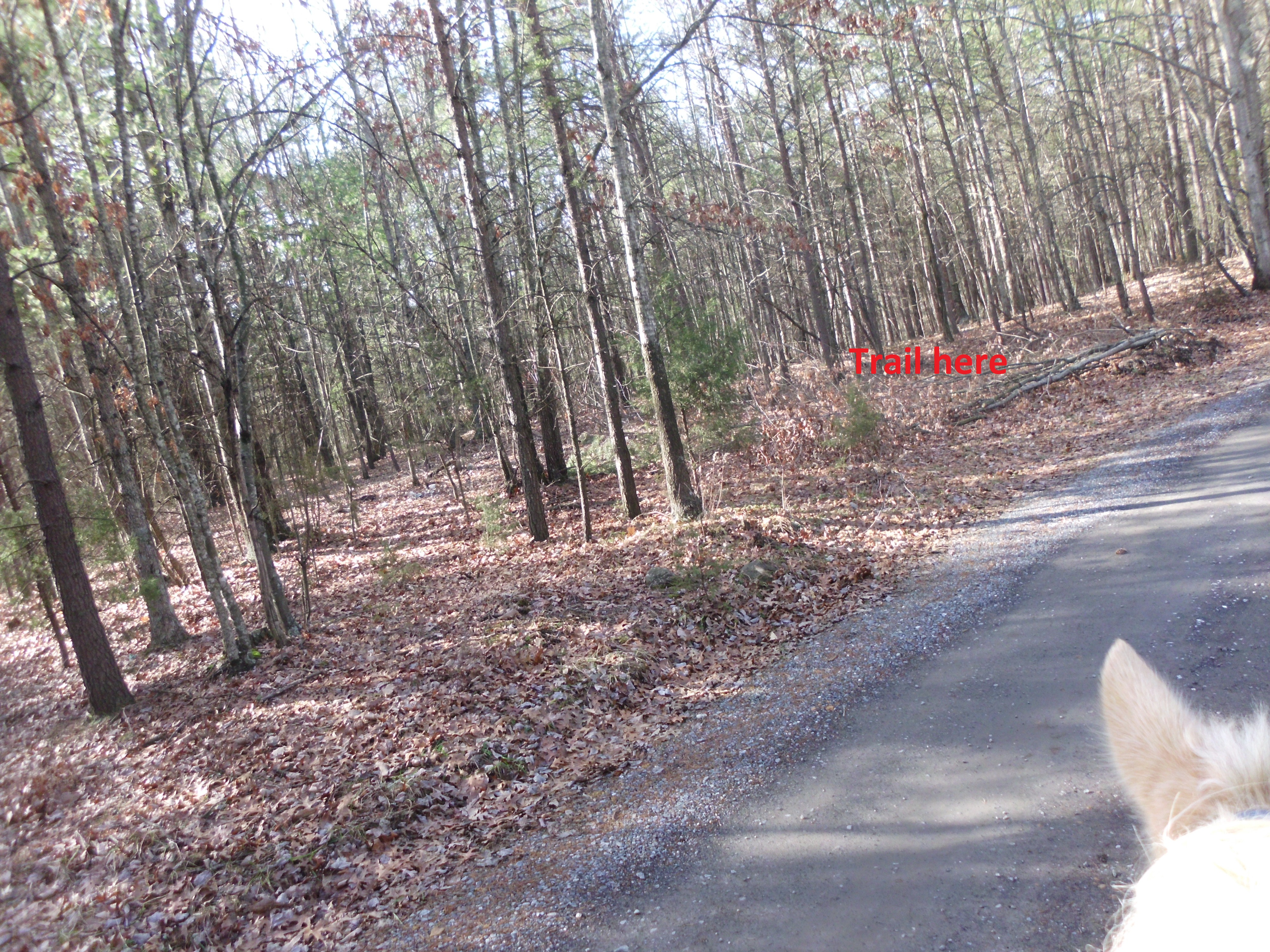
I had the map out as I went up the main fire road and I followed it as closely as possible.  Just before the first bend in the FR is a slight trail to the left.  This is where I had originally thought the first fire road turn might be, but it was just a short trail that went a little ways and then trickled into more of a hunters foot path.  Up to that point it was a nice little trail though, rather clear and easy to navigate.  I saw boot prints and other signs (trash) of recent use. 
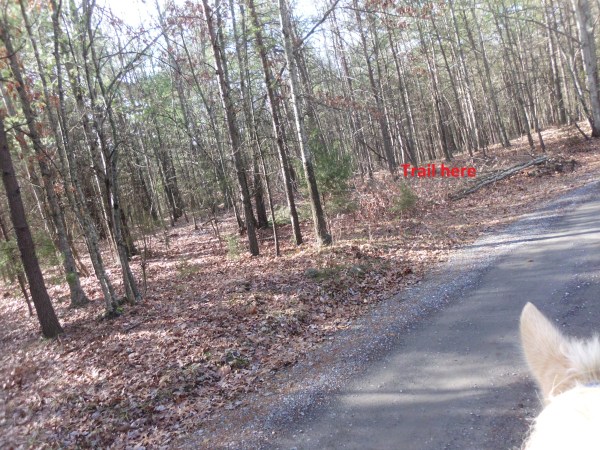
This trail is now marked on the map above in black sharpie. 

I continued on the main FR through a few more bends and curves which are not designated on the map and I came to a pull over on the left.  It had recently been used, and there were even signs of horse trailer parking (small dustings of horse poo that clearly came out of a trailer).  A dead rotting deer carcass, some other odd dumped debris including what appeared to be some type of upholstered vehicle seat. 
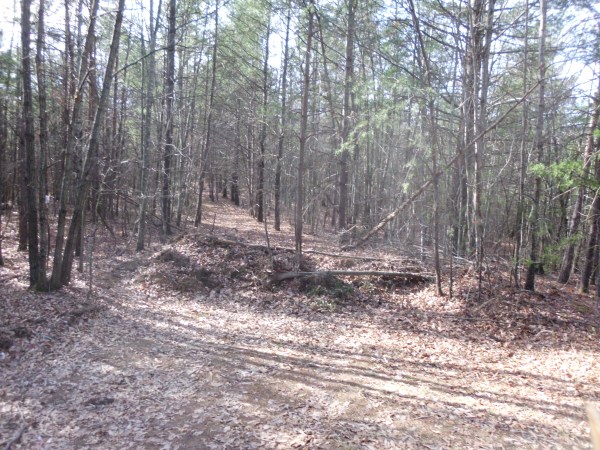
When facing this pull over, to the left side of it is a trail.  I took this trail and it was very clear and prominent but after a very short distance it evaporated and is clearly used by hunters and probably no one else. 
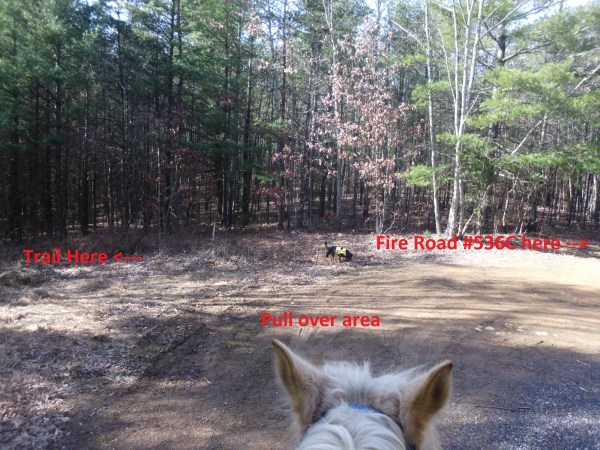
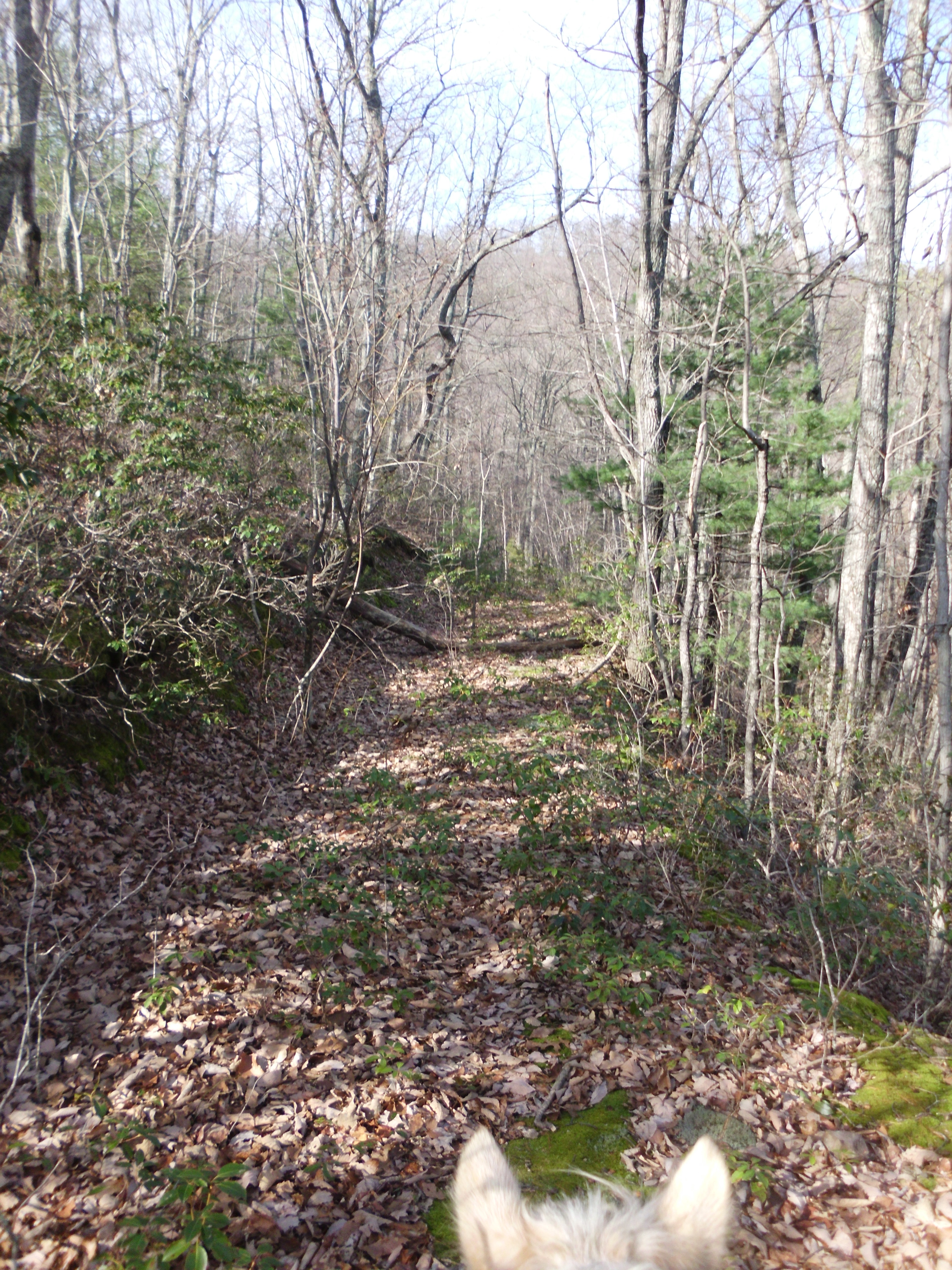
But to the right of this pull over are a couple berms, some large, that sort of face out in two directions.  I *believe* this is the first fire road turn FR536C.  I headed up it and followed well cut trails over and around the berms and followed a trail with a slight incline.  It is the width of a fire road, but heavily over grown with small trees and bushes.  The trail that cuts through them is well defined and clearly used.  I saw boot and hoof prints on this trail, several clipped back and broken back branches at rider height, and it was clear enough to get in a bit of a trot and canter at some points.  It wound around pleasantly for a good ways, with a slight incline and eventually reached a branching point. 

The branch appears to have three directions, left, right and straight.  I continued straight and the trail wound along pleasantly.  At one point you ride on sort of a ridge along the side of a hill, it appears to have been cut and then overgrown but with a nice worn path winding along it.  This portion of the trail abruptly ends at a washed out area.  There is a man made water hole (probably a gross stagnant mosquito breeding ground in warm weather) and the general area around it appears to be rocky and probably swampy flooded in the wet spring. 
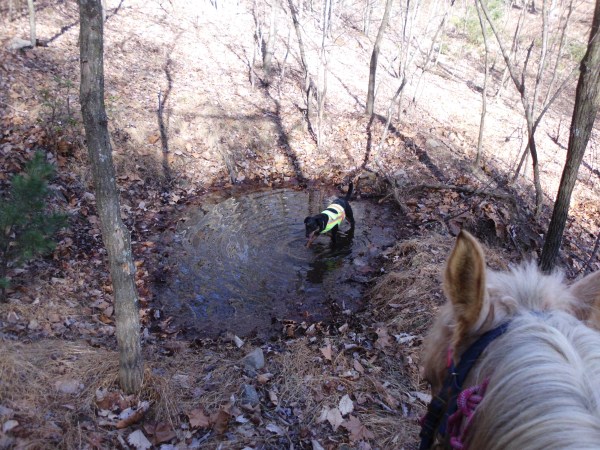
I did not see a point at which the trail continued from there.  The area is very heavy in leaf litter and with it being a wet area for part of the year, it is highly possible that the trail is hard to follow at this point, and I was simply unable to find it.  There is a bit of a creek bed that angles off to the left, although I didn’t really have interest in pushing my pony to stumble along a dried out rocky creek bed with all the pitfalls being covered in a foot of brown leaves.  There also appeared to be somewhat of a path ahead and slightly to the left heading steeply up.  I did push along it for a shot while but with it being so deep in leaf litter and very unclear if it was the actual trail continuing and not just a deer or other critter path, I decided to call it quits at that point and turned around. 

I returned to the branching point and tried the trail that would have been to my left when riding up the FR, but was now to my right, riding back down it.  It crossed a small berm and headed out on a similarly clear and level trail, that appeared cut and officially placed. After a short way there was another trail that branched to the left, which I will describe in a moment.  Continuing ahead on the trail, it remains a clear cut trail with a well worn and used path, and I continued to see signs of foot and horse traffic.  It winds along for a ways with a few inclines and some levelish areas.  At one point you are on a cut trail, needing a bit of clean up but still well defined, wrapping around the edge of a hill, and you can see the trail you are on continuing to wrap around and eventually turning to run directly parallel  to your current position. 
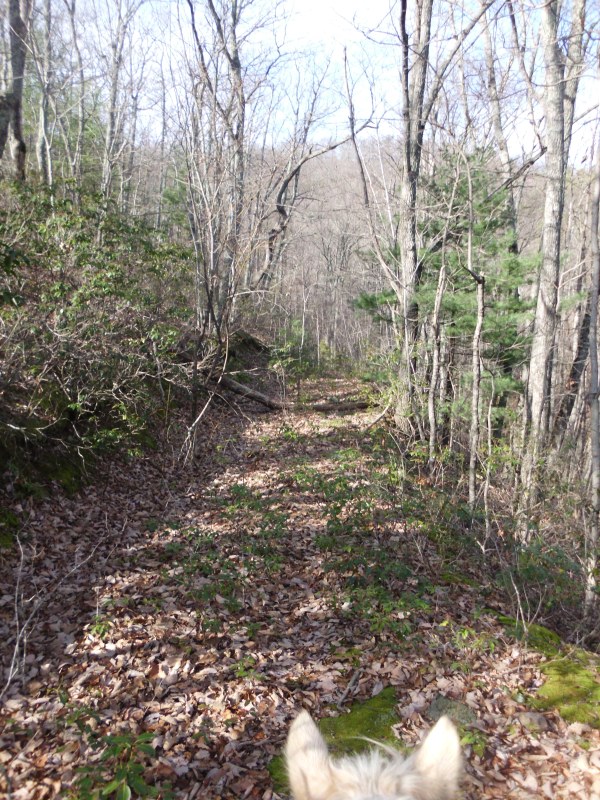
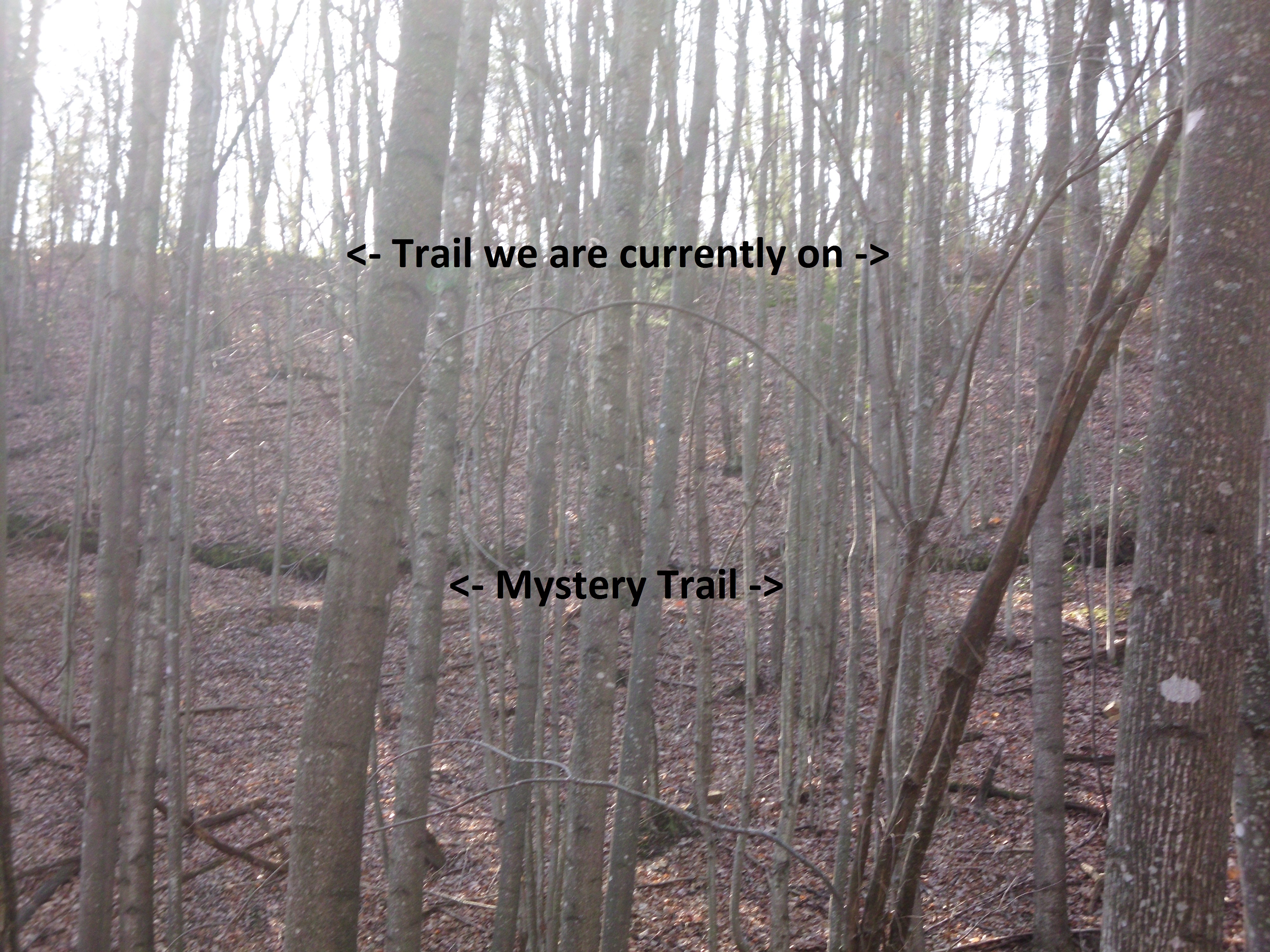
At about this point you may also notice another clearly cut path, running along the side of the hill but below the trail you are following.  It is very clear and appears man made and used.  but trickles out and appears to dead end a few yards steeply down from your path.  I will have to investigate this mystery path on a future ride.  It will probably require dismounting and sliding down the hill to it or trekking a longer distance through the woods to reach it with less of a decent. 
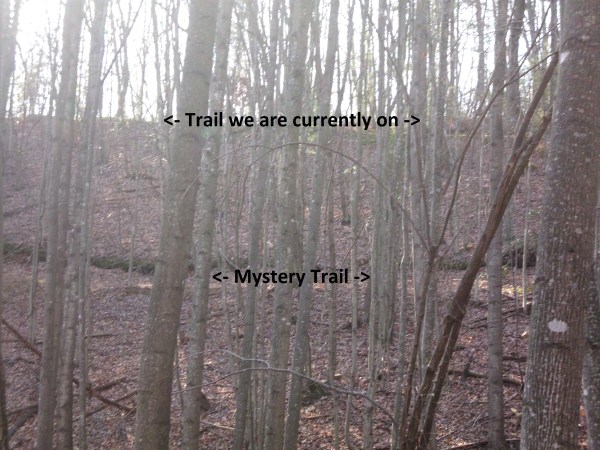
The trail you are currently on continues and eventually begins a steep climb into deep leaf litter, making a sharp turn right, and climbing.  I stopped at this point, as the trail was hard to follow in the leaves and was very steep and I was not interesting in going back down it later.  I will investigate in the future though. 

I returned along that trail and took the branch from it that is now on my right, but was on my left as I began the trail.  It is also well cut and clear, and travels clearly for a semi short way to what appears to be a clear camping area.  The trail then continues out the other side of the clearing and on down through deep leaves and towards a dry creek.  It is possible that this trail meets up and becomes the mystery trail I have yet to investigate.  It is headed in that direction.  But I had been out for quite a while at this point, and the trail was becoming hard to determine in the low leave and deep leaf litter, so I decided to call it for the day and returned. 

I did not have time to investigate the trail to the right at the main branching point.  and I returned to the main fire road and headed back out to my trailer.  I would suspect that this is the first fire road branch # 536C and it is simply over grown and mostly unused.  I did not see any sign of the gate that is marked on the map, but there were several berms at the starting point.  the FR was quite over grown with young trees and bushes but could have been better maintained in a time of greater economics. 
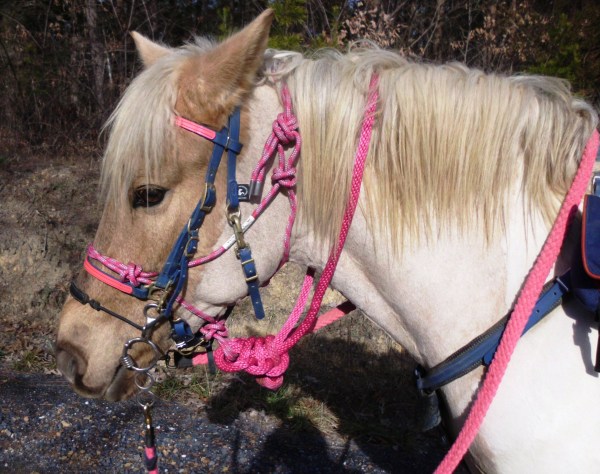
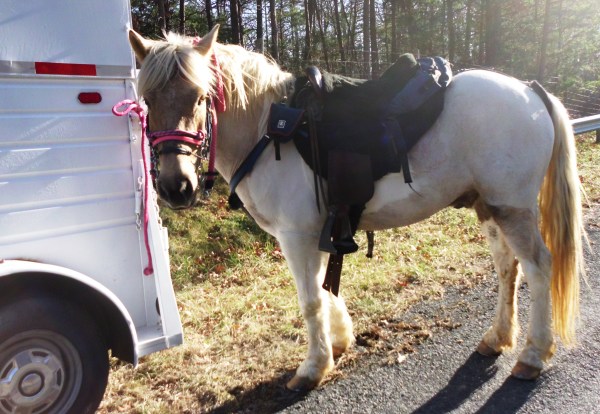
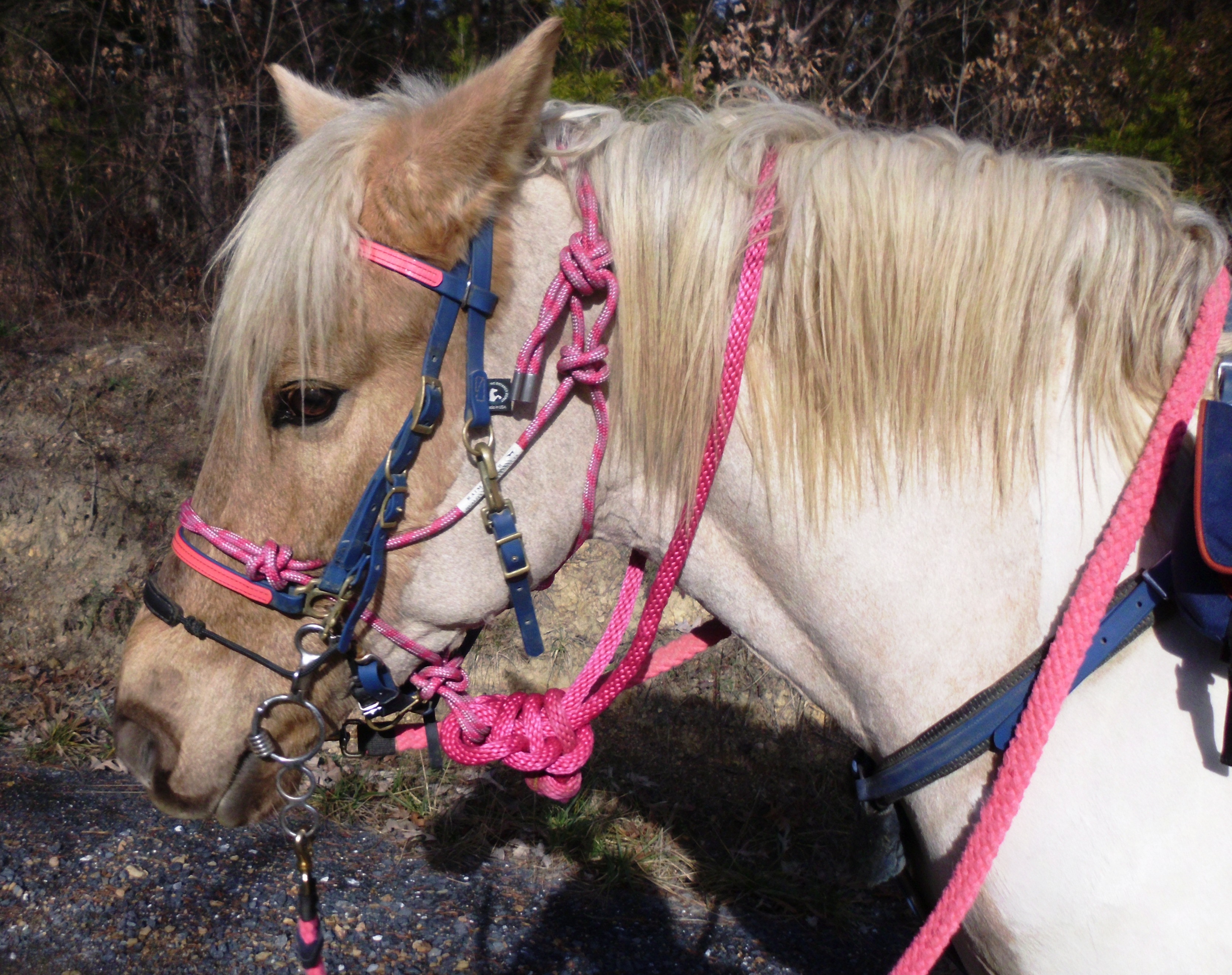
Simon thinks this might just be a little too much pink.

I will have to return and continue to explore this direction and all the side trails and paths.  and also explore father along the main FR to be certain that this is the first FR branch #536C.  But, at this point, I am pretty certain it is. 

I will state that it baffles me that the Forest Service does not include these trails more clearly on the maps and mark them more prominently in the woods.  These are excellent trails and clearly a lot of man power went into creating them at one time.  It would also be easy to become lost and turned around on all these unmarked trails, and a person with a lesser sense of direction would not even be able to clearly reference a map for assistance.  I am aware that you are allowed to go anywhere in the forest, but are not to create unsanctioned trails.  But since this FR is marked on the map, but not marked in person, it makes determining if this is the actual trail that is sanctioned hard to determine.  I also realize that the Forest Service works with extremely limited resources and have a high and probably difficult chain of command for actions and funding to trickle from.  But it does seem like a bit of a waste of resources to let trails that appear to at one time were well defined to become unmarked and often, unused, trails. 

This has me reflecting on the trail 439 which I navigated a few weeks ago and comment on in post https://blueridgepony.wordpress.com/2011/12/21/bear-trap-exploration/ that previously had nice wooden signs clearly marking both access ends, but which has since then had the signs removed and simple green tree tags put up in their place.  These are much harder to find, and much harder to read, and also provide less information for the forest visitor.  I do not see an advantage to removing the already present and more informative sign in place of a lesser one.  I am sure there is a reason that I just don’t know about.