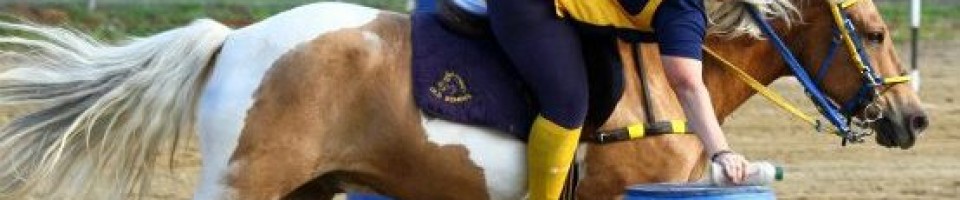
A few posts ago I mentioned that I would talk about the differences between MGAA and USMGA, the two main games organization in the US. All observations are just that, observations. And I mean in no way to frown upon either one, as both have their positives as well as their negatives.

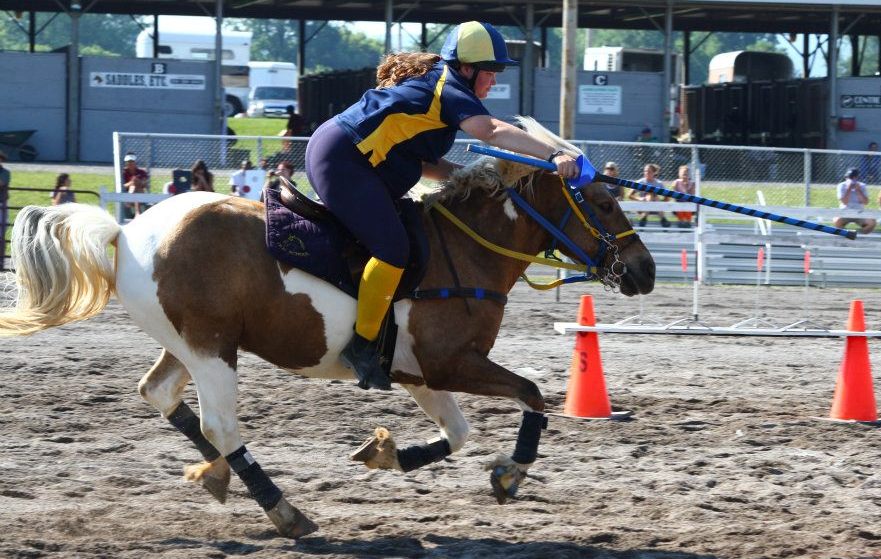
Brea and pony Jabubba
MGAA’s Mid-Atlantic #2 ~ Masters
Photo: Genevieve of EquiStar Photography
There are currently three organizations in the US that offer mounted games competition opportunities. I am not including local gymkhana, fun show, barrel and generally western gaming competitions because, although they have similar aspects, they are not the same thing. One of the defining aspects of a mounted games competition is that riders are required to sign up for the entire competition. In gaming and gymkhana events, riders may select specific classes and races they wish to take part in. With mounted games it’s an all or nothing singular event.
United States Pony Club

Addie and pony Tommy
MGAA’s Mid-Atlantic #2 ~ Masters
Photo: Genevieve of EquiStar Photography
One of the three organizations offering mounted games opportunities is the United States Pony Club. Some pony club regions offer one mounted games rally a year for members to participate in. Riders must be a member of USPC to enter, and are divided up into different divisions by age, with 18 being the oldest a rider may be to take part. Winning teams of a regional rally may take part in Championships for their section of the country if games is being offered. I am not very familiar with Pony Club outside of the east coast, which does currently offer games at champs.

Brian and pony Squiggles
MGAA’s Mid-Atlantic #2 ~ Masters
Photo: Genevieve of EquiStar Photography
Regardless, I discount Pony club as a games organization, because it is a youth educational organization that introduces riders to an array of disciplines. Games is one of the many equine events PC offers and is not the focus of the organization. I also discount it because it restricts entry to its games competitions to only Pony Club members and they must be under the age of 18.
This leaves two games organizations which I will introduce and then discuss the differences of.
Mounted Games Across America

Genevieve and Pony Dj
MGAA’s Mid-Atlantic #2 ~ Intermediate
Photo: Linda of EquiStar Photography
The larger of the two organizations is MGAA – Mounted Games Across America. MGAA covers most of the east from New Hampshire and the northern states, down through the Mid-Atlantic region including New York, Pennsylvania, Maryland and Virginia and into the Carolinas. It extends out into the southern Midwest from Georgia up through Kentucky, Ohio, Illinois, Indiana and into Michigan. It is a relatively newer organization, awarded its nonprofit 501c3 status in 2004.
MGAA operates under an elected board of governors that adhere to restricted term lengths and limitations on repeated terms in office. A detailed bylaws is followed that was updated earlier this year. MGAA released their own, extensively detailed rulebook in late 2010 with a new revised 2012 edition being released later this summer. MGAA has detailed rules for over 30 races that include team, pair and individual versions of play and adds new games on occasion.
United States Mounted Games Association
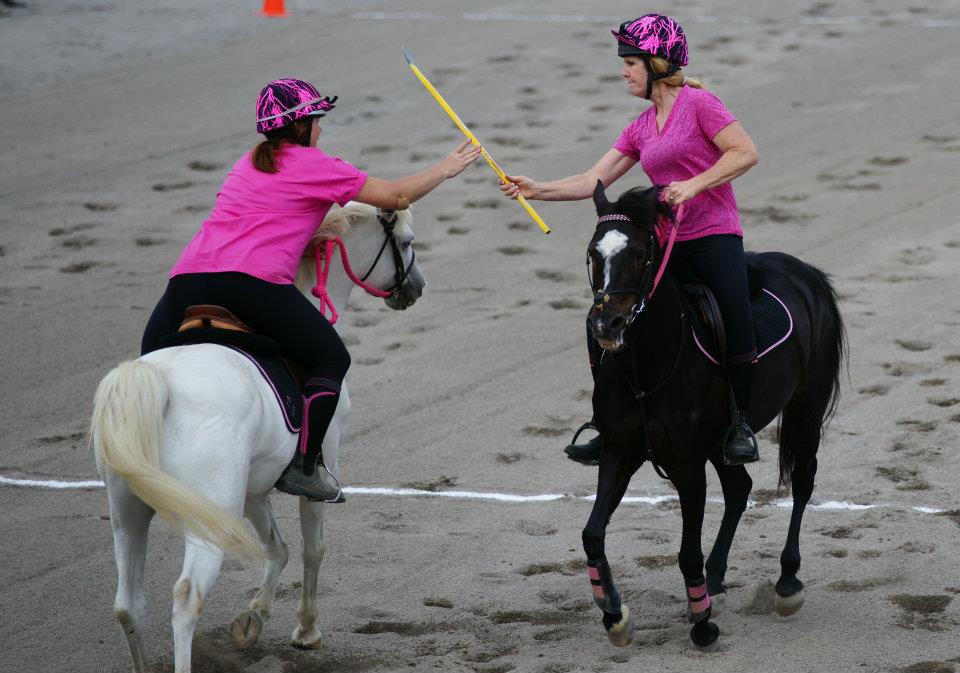
Stacey on Simon and Nancy on Marley
MGAA’s Mid-Atlantic #2 ~ Fossils
Photo: R Crowley
USMGA – United States Mounted Games Association is the other mounted games organization in the US. USMGA holds the representation for the US as members of IMGA – International Mounted Games Association. It is a much older organization, with US affiliation dating back to the late 1980s, when mounted games was a much smaller discipline in the US and across the world. USMGA has changed hands over the years and the modern USMGA is much larger and more active than the older organization was. In general I will speak of the newer USMGA, which was primarily established around 2000.
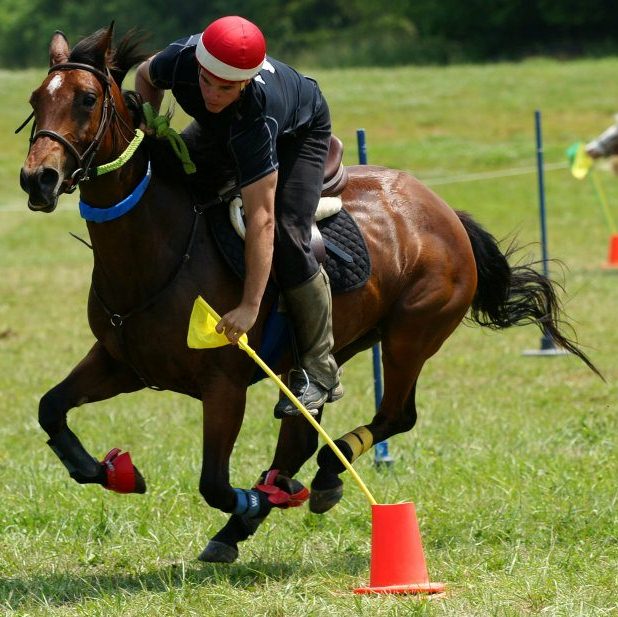
Tommy and pony Tigger
USMGA Champion Series #2 ~ Norman Patrick
Photo: R Crowley
USMGA has members in the east, but is primarily positioned in the Midwest, in Kentucky to be specific. The majority of their competitions are held in Georgetown at the Kentucky Horse Park as well as in Ohio. Last year was the first year they offered a competition in the east, again speaking of the newer USMGA, which was held Memorial weekend in Doswell, Virginia. The former USMGA that operated primarily in the 90s was exclusively in the east, seated almost entirely in Virginia, Maryland and Pennsylvania. This year USMGA is offering two east coast competitions. One was held in West Virginia over Memorial Weekend and one will be held in New Jersey in September.
The two organizations, MGAA and USMGA generally offer competitions of a similar format and design, with many of the races being exactly the same, and the general format of play also matching. Riders can easily participate in one organizations competition one weekend and attend a competition hosted by the other the following weekend with very little alteration. But there are also several differences some of which I will touch on below.
Divisions

Hunter and pony Jiminy
MGAA’s Mid-Atlantic #2 ~ Masters
Photo: Genevieve of EquiStar Photography
MGAA offers several divisions including Beginner Novice, Novice and Green Pony. But the primary divisions continuously offered consist of Intermediate, Masters and Fossils. Intermediate and masters are open to riders of any age, and allow riders to select which division they feel their skill, speed, physical fitness and pony best fit into.
- The intermediate division is devised for riders that are learning or still perfecting skills, developing skills at speed or that wish to ride at a slower pace. It is a good option for skilled experience riders to take their training ponies into for experience, as well as riders recovering from an injury or time off. This division is for your newer competitors, your slower competitors and those that are not ready for, or no longer fit into the masters division.
- The masters division is developed for the skilled, experienced games rider, that plays with speed and accuracy and is riding a skilled and experienced pony that has some speed. Vaulting is a near essential skill to have perfected to be a successful Masters rider. This is the division for your top games competitors.
- The fossil division is restricted to riders 21 years of age and older, and prohibits riders that are currently active masters players from taking part. It is generally for riders that are no longer in their prime, or may quite frankly, be well past their prime. This division is surprisingly competitive, and is frequented by extremely accurate players who navigate their races at a good canter and gallop. Many Fossil riders can vault onto their pony, but the speed, skill and physical physique of a fossil rider vaulting onto their pony, when compared to a masters rider, is extremely dissimilar. The fossils division is made up of a diverse selection of riders, where some may have physical limitations, or lack the experience or skill that others have already acquired. To the point, there is no fossil beginner/intermediate and fossil masters options. In this division, all of these riders are grouped together.
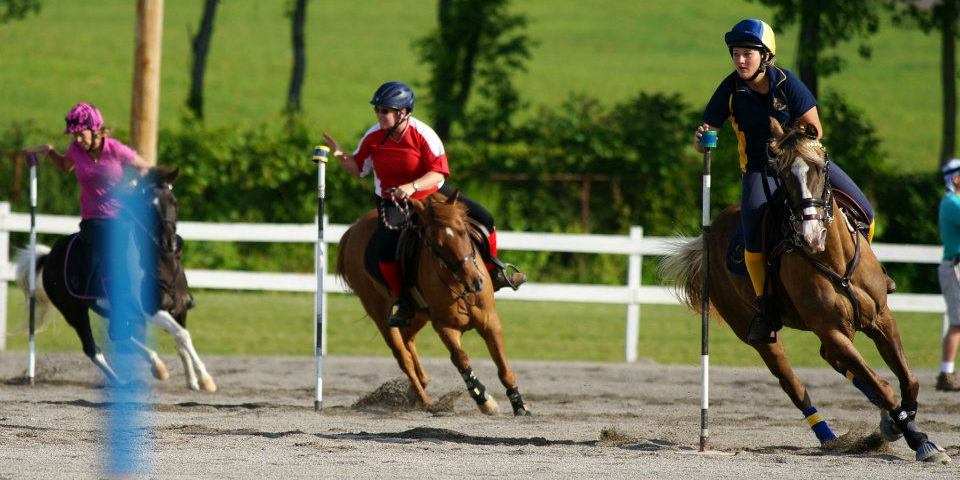
Anita on Pinto, Kim on Chance, Zoe on Cheyenne
MGAA’s Mid-Atlantic #2 ~ Fossils
Photo: R Crowley
USMGA also primarily offers three divisions, Open, Under 17 (U17) and Norman Patrick (NP). Where MGAA restricts the under age limit in their Fossil division, USMGA has an upper age limit on their U17 division, which quite obviously requires riders to be under 17years of age to take part in it.
- The under 17 division is a mish mash of MGAA’s intermediate and masters division. The riding level varies and may include riders that are very young or very new to the sport as well as some of the young, but still top skilled and experienced players. This division is set up based on age.
- The open division is closely lined up with MGAA’s Masters division, although it generally requests riders to be over 17 years of age, it is not overly restrictive on this and many riders under 17 years of age ride in both Open and U17 divisions. Generally a rider over 17 years of age that is new to the sport or riding a new pony would be encouraged to enter the NP division instead of the open division, although there may be slow or inept teams mixed in with the top teams in the sport.
- The Norman Patrick (NP) division is closely related the MGAA’s intermediate, green pony and fossil divisions combined. There are no restrictions for this division and Open riders may have their new or second pony in this division. It is also frequented by younger teams that are still learning the basics of play, as well as adults of varying skill and speeds.

Linda and pony Blue
MGAA’s Mid-Atlantic #2 ~ Fossils
Photo: Genevieve of EquiStar Photography
There are pros and cons to the way both organizations outline their divisions. I like that MGAA allows riders to fit into divisions by skill vs age. This makes it possible for riders starting the sport at different ages to more easily fit in. In a competition with a large turnout, I feel keeping riders restricted by skill and experience makes for a safer environment. It also seems to make the competition more thrilling as more teams are neck and neck, and evenly matched.
Although, allowing riders to select their own division, does allow riders to move up to masters before they are ready for it. It also allows riders to stick around and have the possibility of dominating the intermediate division when they should move up to masters. It is additionally possible for adults and older teens to ride against young kids in intermediate. The perception could be garnered that the younger riders are being “beaten up on” by the older riders. Age restrictions prevents this. Organizers and officials at competitions are granted the option of speaking up if a rider/team is in the wrong division, but often it is too late at that point.
The open, anyone is welcome, format of the NP division, prevents the adult set from having a division all their own. Similar to the intermediate division in MGAA, it is possible for a young and athletic team to dominate that division. Although USMGA lacks a large adult turnout and operating a division singularly for adults is not possible to date. Having the division open as a catch all, makes it possible to incorporate opportunities for a larger range of riders that otherwise would not have enough competition to take part.
The Games

Sam on her new pony
MGAA’s Mid-Atlantic #2 ~ Masters
Photo: R Crowley
Another big difference between the two organizations would be the variety of games.
MGAA offers all of the same games USMGA offers with identical rules and instructions of play. But MGAA also offers a large selection of other games, a few adapted from Pony Club, and many completely new and original to MGAA. This makes it possible for riders to play a large variety of races, with the possibility of few repeats at a single competition. Many find this more exciting and enjoy the variety and that races are targeted at a larger variety of skill and diversity for the rider and pony. Although some prefer the limited selection USMGA offers because its fewer races to practice and perfect, and some feel that the races that are played are the strongest exhibition of a traditionally skilled games rider and pony.
Perhaps change is scary, which adding new races, and thereby, new skills, can be. While, the old trusty, tried and true, are proven races, adding fresh new races also adds challenge and diversity to the sport, keeping it from becoming repetitive.
The Equipment and Setup

Joy and pony Vegas
MGAA’s Mid-Atlantic #2 ~ Fossils
Photo: Genevieve of EquiStar Photography
The equipment is generally the same between the two organizations. Flags and sticks are the same length, cones and poles are the same height.
The minor differences can be a bit of a challenge for some riders to adapt to quickly, but are inconsequential in most cases. They can be compared to the same differences between one set of competition equipment vs another set within the same organization.
This is a factor in part because some of the equipment is homemade with loose standardization, so weight and size may vary to a degree. This is seen frequently with bottle shuttles and swords. Another factor is the change in what is commercially available. A good example would be mugs, where in years past 16oz was easily found as the standard size, but has more recently been replaced by a 12oz manufactured standard.
Competition Layout

Regan and pony Cinnamon
MGAA’s Mid-Atlantic #2 ~ Masters
Photo: R Crowley
The competitions are generally laid out very similar. Each division enters the ring and rides a session of consecutive games.
An MGAA session generally consists of 12-15 races played consecutively in a 45 minute to an hour long time frame. Teams for a new session enter the arena as the previous session is leaving, and are allowed a few minutes to warm up in the arena and pick their lanes as they please.

Sarah and pony
MGAA’s Mid-Atlantic #2 ~ Masters
Photo: Genevieve of EquiStar Photography
USMGA sessions generally consist of 8-12 consecutive races, that take an hour to an hour and a half to complete. Teams are called into the arena in the order of current placement, and are asked to parade around the edge of the field of play and then line up in the lanes in the order of placement.
The entry with parade does provide a more organized and better presented entry, but with lack of spectators if feels a bit pompous and a simple waste of time. Riding next to the teams placed closest to your own is enjoyable and allows teams to see their placement more easily. I do enjoy this aspect, although I can see how this could add pressure to some riders. I can also perceive how it could cause unrest if the team constantly placed next to you has continuous interferences in play with your own team, or particularly cranky ponies behind the line that effect your own team’s ponies. By allowing teams to select their own lanes, a team can jockey for the lane that best suits their own needs.
Perhaps USMGA is able to take a slower pace, with greater breaks between races and sessions because they generally only run one heat per session. MGAA often has two or sometimes three heats in some divisions running in each session. So instead of running 1 heat of three divisions for a total of 3 runs through each session, they may have a total of 5 heats across the three divisions, meaning they have to run two additional heats per session. This adds up, particularly in the case of running two sessions in one day. Having two more heats in two sessions would add an average of 4 additional hours to an MGAA schedule.
Work Shifts

Mackenzie and pony Inky
MGAA’s Mid-Atlantic #2 ~ Masters
Photo: Genevieve of EquiStar Photography
All games competitions require a lot of manual labor during a competition. An assortment of judges are needed to assist the chief referee in looking for infractions in play. Mounted games also requires a new set of equipment to be taken down and set up for each race. Both organizations have their work set up slightly different.
Although the standard for MGAA may vary slightly from one competition to the next, in general all teams provide assistant referees for one heat per session and also provide ring crew workers for one heat per session. In most instances a team will provide their workers in the heat that takes place two after their own. Although on occasion a team is required to provide a pair of equipment workers during their own session instead.
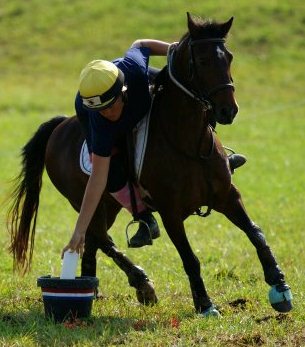
Leah on pony Rudy
USMGA Champion Series #2 ~ Open
Photo: R Crowley
USMGA also requires teams to provide assistant referees for a heat other than their own. They also require teams to provide equipment crew. The difference lies in USMGA requiring each team to provide their own equipment crew during their own session. The idea is for the team’s crew to set their specific lane, and their lane only.
As a team that does not travel with a large contingency of family and supporters, it is often hard to find someone to work the ring during our session. Often it is possible to ask a friend’s team in another division to swap work sessions. Although with less heats, this can cause issues with getting one’s own pony tacked up and to the ring on time, or untacked and put up in time. I could also see this as particularly difficult for a team that is newer to the sport, or organization, and that does not know as many people and other teams to swap shifts with.

Kelsey and pony Coco
MGAA’s Mid-Atlantic #2 ~ Masters
Photo: R Crowley
Another aspect that seems a bit needlessly laborious, would be setting ONLY one teams equipment. With all ring crew working as a team, all of the teams can have their equipment set up in a quick turn around with minimal ring crew labor. But with each team riding needing their own team of equipment crew, this can take more people and a lot longer to complete. For example, in a race with a simple set up like Mug Shuffle, where a single mug is placed on the first and the third pole of each lane, only two workers can set this up in a mere minute. One worker takes the line of first poles and one worker takes the line of third poles. Each worker crosses the arena placing one mug on each first or third pole, there by setting up ½ of each lane quickly.

Annie and pony Bela
MGAA’s Mid-Atlantic #2 ~ Intermediate
Photo: Genevieve of EquiStar Photography
In contrast, with each team needing their own ring crew, this requires either one person per lane to place two mugs in just their own lane, or two people per lane to place one mug on each pole. Either way, that requires a much greater amount of energy and time to complete. The advantage I can see though with a team having their own personal ring crew is they can guarantee their equipment is set to the best of standards, and if something is messed up because of improper set, it is on their own team. Perhaps in much larger competition formats with 100s of teams running and a greater thrust to beat out the competition, a bit of sabotage could occur, and by having ring crew per team, that could be avoided to a degree.
Rules

Alicia on her pony
MGAA’s Mid-Atlantic #2 ~ Masters
Photo: Genevieve of EquiStar Photography
Although for the most part, the rules of play are just about the same, there are some differences that should be noted. And as always, when participating it is helpful to review the rulebook of that organization in particular.
MGAA has a rather new, and rather extensive rulebook. It was originally released in 2010 and since then has had quite a few edits, additions and changes that have been released. A new version that will include all of these changes is due to be released this summer.
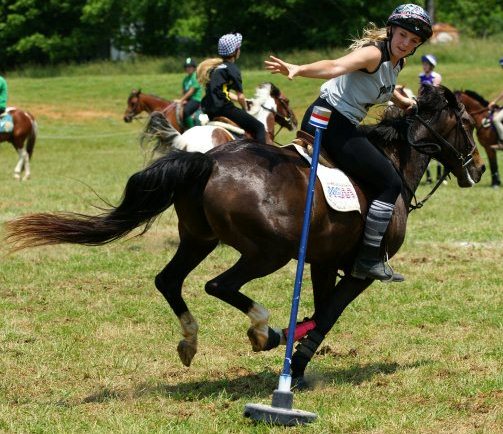
Brett on pony Gemma
USMGA Champion Series #2 ~ Open
Photo: R Crowley
USMGA, as part of the International Mounted Games Association, uses the rulebook released by this international body, that governs all MGA branches. It is a much slimmer book that is rather to the point and conveniently fits into a pocket.
While MGAA’s rulebook is a behemoth compared to the IMGA rulebook, it does leave relatively little to question. The organization has made an exhausted effort to write the book so that a person new to the sport could pick it up and begin playing. It has also made labors to remove as much interpretation for referees, loop holes and questionable play as possible. While IMGA has a much easier to digest rulebook, it does require the user to already have a basis of play, and leaves some possible interpretation to the host.

Rachel on pony
USMGA Champion Series #2 ~ Open
Photo: R Crowley
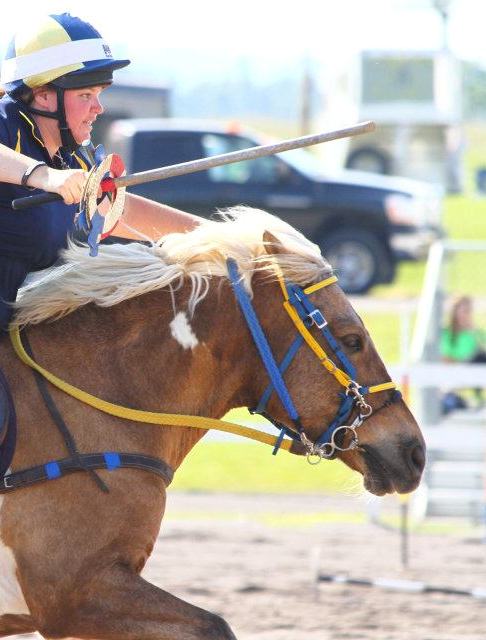
The minor rule differences can also be marked in what type of equipment and tack are allowed. Where IMGA only allows snaffle bits, MGAA has opened the door to an array of different bits, including popular bits that work on different types of ponies, such as hackamores, kimberwicks, western bits, leverage bits and combination bits. This allows for riders of none traditional English backgrounds, which is particularly mindful of the US where many come from a western background. It is also appreciated by riders who have ponies that do not fit the typical mold and may work better in other devices. Allowing the rider to select what works better for a particular pony, often makes for a better bitted and more responsive pony. USMGA follows IMGA in their bitting requirements, sticking to only snaffles, but they do allow ponies ridden in their Norman Patrick division to ride in any bit they feel comfortable in. Another minor difference of note would be that IMGA does not allow riders to wear jewelry, where MGAA has no restrictions on this.
Officials

Ashley and pony Romeo
MGAA’s Mid-Atlantic #2 ~ Masters
Photo: Genevieve of EquiStar Photography
Both organizations’ officials follow very similar standards. The notable difference would lay in MGAA having a rooster of chief referees with a short list of nationally qualified and experienced ones. Where USMGA generally uses the same chief who they employ from overseas.
The difference is most likely very simple and easily explained by understanding that USMGA has only a few large competitions a year, which they run to the IMGA standard of play. This is accomplished with the skill and experience of an international referee. MGAA has a full calendar of large and small competitions spread throughout the east and Midwest parts of the country, often offering two large competitions on the same weekends in opposing regions. Having a larger pool of semi local referees to pull from makes it possible to accomplish this.
Although I find all of the referees I have ridden under in both organizations to be excellent and professional, in both small and large competitions, and I see no fault in having a smaller pool to draw from, I do find that having a larger selection of trained and qualified local professionals to be an advantage. It also seems to generate more critiquing and perspective on possible rulebook edits and clarifications from the perspective of many experienced individuals. I am sure IMGA finds the same thing with their pool.
In contrast, MGAA makes efforts not to have a referee assigned to a division a family member is riding in, with the closeness of games riders, it is virtually impossible to avoid having a completely impartial referee, and having ones that are local, makes this even harder. I feel that all the referees make strong and sucessful efforts to be impartial, although there may always be the perception that favor is being garnered.
Organization Setup

Mitchel and pony Dusty
MGAA’s Mid-Atlantic #2 ~ Masters
Photo: Genevieve of EquiStar Photography
There are large differences in how the two organizations are set up and operate.
MGAA operates by an elected board of governors that meet strict bylaw requirements, voting practices, and in general, democratic procedures. No more than one family member may serve on the BOG at one time. Terms are limited in length of one or two years and terms are limited to two consecutive. MGAA is a 501c3 nonprofit which adds additional restrictions and requirements. MGAA has developed its own lengthy rulebook that governs all competitions.
USMGA is owned with paid employees and little member voice, set up as more of a dictatorship or monarchy. USMGA operates as a branch of the international organization, and follows the rulebook and requirements set by the international division.

Lexie on pony Glory
MGAA’s Mid-Atlantic #1 ~ Masters
Photo: R Crowley
While I personally prefer the democratic operation, there is no perfect process and there will always be politics involved, even if they are simply perceived to exist. MGAA’s setup tends to take time, as a BOG of 9 members spread out in varying locations can take an extended time to come to even the simplest resolutions. It is always possible to have a BOG that is one sided or leans to a specific way of thinking, with term limits and elections, this can only be for a restricted period of time.
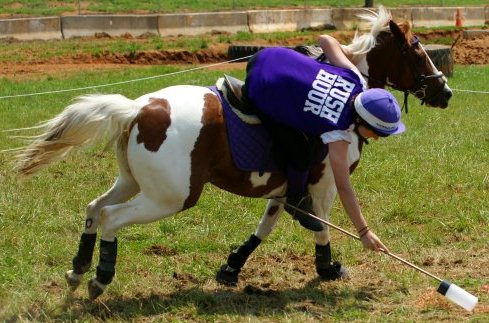
Laura on pony Cookie
USMGA Champion Series #2 ~ Open
Photo: R Crowley
With an organization having ownership by an individual or family, it allows that individual or family full control, regardless if it is for the whole organization’s best or not. And regardless if they do, the perception will never be seen as fair and equal. There is a greater possibility to make things unpleasant for those that cause trouble or are disliked, and to make things better for those that win favors, even if it is no done on a conscious level. An advantage though, with a dictatorship is that resolutions are quick and to the point.
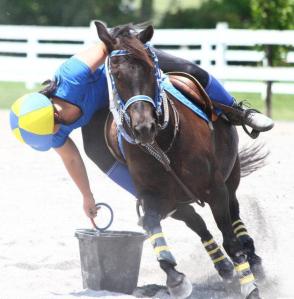
- Megan and pony Misty
MGAA’s Mid-Atlantic #2 ~ Masters
Photo: Genevieve of EquiStar Photography

Although not perfect, as a young all volunteer organization, MGAA has some room to grow and improve, I strongly support their operations.
In Conclusion
Both organization offer excellent opportunities for riders of all ages, skill and experience to take part in. And while they are very similar there are some pointed differences, which can be taken as pros and cons.
Regardless, both organizations have something they can learn from each other.








 Blue Ridge Pony